
Surgical Master Console Using General-Purpose Robot Arms and a Separable Articulated Distal Interface: Porcine In-Vivo Evaluation
High-performance surgical master consoles are expensive and hard to reproduce, while commercial haptic devices lack interfaces for wrist articulation and continuous grasp. We build the master from general-purpose 6-DoF robot arms and concentrate everything surgical in a separable distal adapter — a 2-DoF direct-drive wrist, magnetic grasp sensing and clutch input — for about US$5,500 the bimanual pair. One endpoint-independent master state drives either Isaac Sim or an RCM-constrained dual-FR3 platform, with at most 8 ms from publication to target update, and the console was used throughout a porcine cholecystectomy without a single interruption originating from it.
A surgical master console has to do three things at once: command an articulated wrist, sense a continuously variable grasp, and let the operator re-centre their hands without moving the instruments. Dedicated consoles do all three, but they are purpose-built and hard to reproduce. Commercial stylus haptic devices are obtainable, yet a stylus supplies a pose and a single trigger — wrist articulation has to be inferred from the stylus orientation, grasp collapses to one aggregate opening, and adding either means modifying hardware the vendor does not expose.
The approach here is to stop designing the proximal mechanism. A general-purpose 6-DoF robot arm serves as the programmable master base, and everything surgical is concentrated in a flange-mounted distal module: a 2-DoF direct-drive wrist, magnetic grasp sensing, and clutch input. The complete bimanual console costs about US$5,500, and it drove a dual-FR3 laparoscopic platform through a porcine cholecystectomy.
| Item | Qty. | Cost (USD) |
|---|---|---|
| PiPER 6-DoF arms | 2 | 3,998 |
| Direct-drive wrist actuators | 4 | ≈720 |
| Grasp sensors + distal MCUs | 2+2 | 40 |
| Printed distal parts, fasteners | – | ≈60 |
| Foot pedals | 2 | ≈40 |
| Frame, arm supports, mounts | 1 | ≈644 |
| Proposed console total | ≈5,502 | |
| Phantom Touch, bimanual reference | 2 | 7,820 |
| sigma.7, bimanual reference | 2 | 96,600 |
One master state, two endpoints
The leader is not kinematically matched to the follower, and cannot be: the trocar fixes a remote centre of motion, so the follower's shaft pitch and yaw are set by the port rather than by any leader joint, and a general-purpose arm carries no joint corresponding to the instrument wrist or jaw. So the console exports operator intent rather than mirrored joint coordinates,
tool pose, wrist angles, grasp scalar and clutch state. The same state drives an Isaac Sim cholecystectomy scene or the physical platform, and mapping, validity checks, safety authority and RCM enforcement all stay endpoint-local.
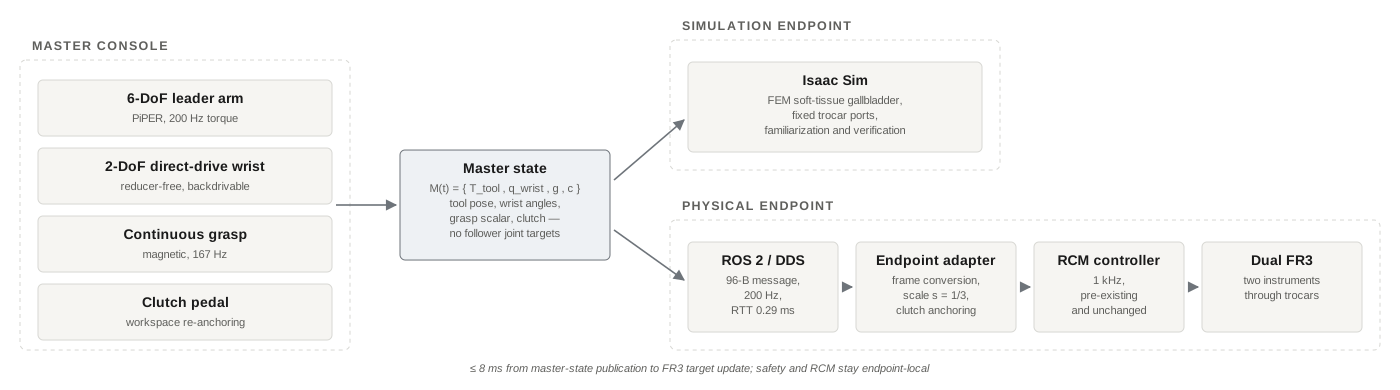
Clutch engagement stores master and follower poses as anchors and maps translation as
with throughout, while orientation contributes only its incremental twist about the tool axis, sent as instrument roll. While released, the follower target tracks the measured tip, so re-engagement re-establishes the offset at the instrument's current pose.
Making a robot arm safe to push around by hand
A general-purpose arm is not built to be hand-guided for half an hour. Torque is commanded at 200 Hz as
where is model-predicted gravity, a joint-wise scale and a residual trim. Because the stock end-effector was removed and replaced by the distal module, the manufacturer's distal-link inertial model no longer describes the assembled leader; the gravity scales that absorb this rise from J1 to J5 on both arms, and left and right were calibrated independently.
| Arm | J1 | J2 | J3 | J4 | J5 | J6 |
|---|---|---|---|---|---|---|
| right | 1.00 | 1.15 | 1.40 | 1.78 | 2.20 | 2.00 |
| left | 1.00 | 1.15 | 1.45 | 1.80 | 2.40 | 1.00 |
The wrist is reducer-free and therefore backdrivable, which is what makes it directly manipulable — and what makes it impossible to calibrate from the datasheet. Four commanded current levels from 0.30 to 1.50 A gave a drive-reported to commanded ratio of 0.631 ± 0.022, and a 4 g load at a 50 mm lever arm gave N m/A. Bidirectional break-away sweeps over 13 wrist postures then separate the two terms,
and the answer was that friction exceeds gravity at every posture tested. A reducer-free wrist near rest is friction-dominated, so holding it with continuous current is both unnecessary and hot. Gating the friction assistance on detected operator motion cut current-flow duty from 89% to 11% and estimated copper loss from 2.7 to 0.3 W; in separate observations the always-on baseline rose from 37 °C to 52 °C within 2 minutes, while the motion-gated test stayed near 36 °C over 8 minutes.
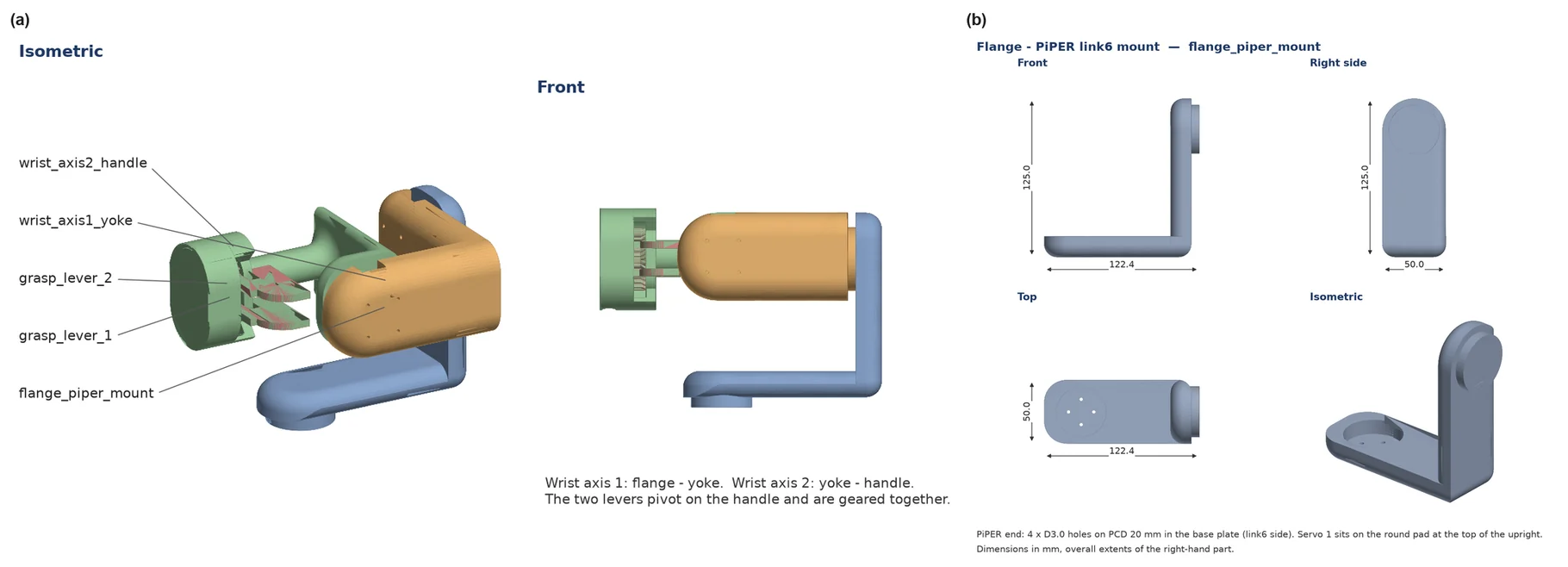
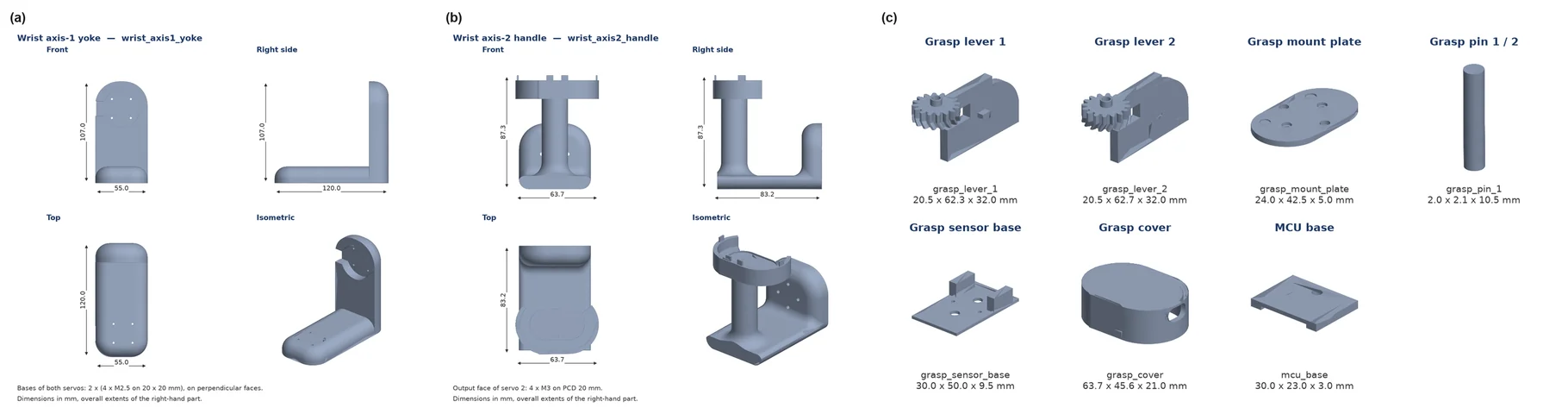
In vivo the grasp channel resolved one 12-bit sensor count — 0.45% of the full right-hand opening — and showed no count change in 99.8% of the 1-second windows in which the lever was held within 2% of full opening.
Bench: what the command path costs
After removing the 230–235 ms delay set by the pre-existing follower controller, the mean error between the commanded tip target and the measured tip fell from 2.11–2.75 mm to 0.31–0.66 mm, with p95 below 1 mm for circular and free-space motion and 2.07 mm for the reversing line. Across four clutch trials, 7.5–14.1 cm of master repositioning produced 0.01–0.04 mm of tool motion during release.
All 6,001 ROS 2 packets arrived; mean round-trip time was 0.29 ms (p95 0.44 ms, max 2.46 ms). Dead time from master-state publication to FR3 target-command update was at most 8 ms, of which the link accounts for roughly 4% — the rest is the 200 Hz scheduling of the robot-side node. That bound covers only the master-side path; the ~230 ms tip lag comes from the first-order response of the patient-side controller (identified time constant 203–205 ms).
Porcine in-vivo
A veterinarian practised for 18 minutes in the Isaac Sim scene through the same physical console, then performed a porcine cholecystectomy. The robotic interval lasted 32.5 minutes, of which 28.4 minutes were analysable — a 3.7-minute patient-side state-feedback stall requiring a software restart was excluded.
No interruption originated from the master console. All 101 pedal transitions changed the engagement state within 0.2 s, and the only engagement change without a pedal command was the software stop at the end. Throughout the 3.7-minute stall the master-state and target-command streams continued with no gap longer than 20 ms while both measured tip poses stayed frozen — which localises the fault to the patient side.
| Measure | Value |
|---|---|
| Valid re-anchorings | 46 |
| Median hand repositioning (right) | 56.5 mm |
| Median instrument motion while released | 0.10 mm |
| Releases below 1 mm drift (right) | 42 / 46 |
| Median command discontinuity at re-engagement | 11 µm |
| Median tip error, delay-aligned (right / left) | 0.28 / 0.13 mm |
| Median roll residual (right, used actively) | 0.32° |
| Postoperative observation | 7 days, no abnormal signs |
For clinical context the session was compared with 120 CMR Versius recordings covering 99 human cholecystectomies. All five operator-side metrics fell inside the range spanned by the clinical data: grip movements per engaged minute sat closest to the clinical median (+0.04 IQR), clutch releases per minute and hand re-centring per release lay at the edges of the interquartile range (−0.51 and +0.53 IQR), and two fell outside it — a lower share of console time spent manipulating (−0.92 IQR) and a higher handle angular speed (+1.65 IQR). The faster handle rotation is what an articulated distal adapter should produce, since the wrist axes are turned directly by the operator's hand.
What this is not
The comparison with Versius is descriptive context, not a matched control: one porcine case with one operator against expert human procedures on a different platform with its own scaling and control characteristics. Overlap in the distributions is not equivalence and not clinical readiness. No force feedback is rendered, a released instrument is not actively held against external load, and leader-arm transparency was not measured directly — so the motion metrics should not be read as back-driving effort. The wrist's two articulated degrees of freedom were exercised on the bench and in simulation, but the rigid laparoscopic follower used in vivo has no distal articulation, so only the roll component reached the patient side and orientation fidelity is reported for roll alone.
CAD, URDFs and the mechanical package are released at mskim1309/ICRA-2027-Master-Console.